Thứ bảy, ngày 6 tháng 12 năm 2025 11:06 SA

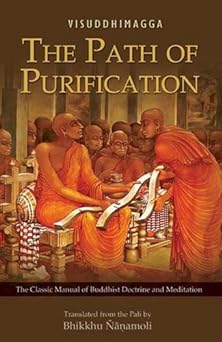
The Path of Purification: Visuddhimagga (Translated by Bhikkhu Nanamoli)

(Tác giả: Bhadantacariya Buddhaghosa - Năm xuất bản 1998)

Index Glossary Tables I to VI

C ontents

(D etailed , b y T opic an d Par agraph N o.)

P A R T I VIR TUE

1. Purification of Virtue

C hapter I D esc ription of V irtue

P a r a. P a g e

I . Introductory 1

I I . Virtue 1 6

( i ) Wha t is virtue? 1 6

(ii) In w h a t sense is it virtue? 1 9

(iii) Wha t are its char acteristic , etc .? 2 0

(iv) Wha t are the benefits of virtue? 2 3

( v ) Ho w many kinds of virtue are there? 2 5

1. Monad 2 6

2. –8. Dyads 2 6

9. –13. Triads 3 3

14. –17. Tetrads 3 9

V irtue of the f ourf old purifica tion 4 2

18. –19. P entads 1 3 1

(vi) , (vii) Wha t are the defiling and the cleansing of it? 1 4 3

C hapter II T he A scetic P ractice s

P A R T II CONCENTRA TION

2. Purification of Consciousness

C ha pter III T ak ing a M editation S ubject

P a r a. P a g e

Concentr a tion 1

(i) Wha t is concentr a tion? 2

(ii) In w h a t sense is it concentr a tion? 3

(iii) Wha t are its char acteristic , etc .? 4

( i v) Ho w many kinds of concentr a tion are there? 5

(v) , (vi) Wha t are the defiling and the cleansing of it? 2 6

(vii) Ho w is it de v eloped?

(Note: this heading applies as far as Ch. XI, §110) 2 7

A . De v elopment in brief 2 7

B . De v elopment in detail (see note abo v e ) 2 9

The ten impediments 2 9

The good friend 5 7

C o ntents (D etailed )

Medita tion subjects , etc 5 7

Temperaments 7 4

Definition of medita tion subjects 1 0 3

Self-dedica tion 1 2 3

W a ys of e xpounding 1 3 0

C hapter IV T he E arth K asiṇa

T he eighteen faults of a monastery 2

The fi v e factors of the resting-place 1 9

The lesser impediments 2 0

Detailed instructions f or de v elopment 2 1

The earth kasiṇa 2 1

The tw o kinds of concentr a tion 3 2

Guarding the sign 3 4

The ten kinds of skill in absorption 4 2

Balancing the effort 6 6

Absorption in the cogniti v e series 7 4

The first jhána 7 9

Extending the sign 1 2 6

Mastery in fi v e w a ys 1 3 1

The second jhána 1 3 9

The third jhána 1 5 3

The fourth jhána 1 8 3

The fi v e f old reck oning of jhána 1 9 8

C hapter V T he R emaining K asiṇas

The W a ter Kasiṇa 1

The Fire Kasiṇa 5

The Air Kasiṇa 9

The Blue Kasiṇa 1 2

The Y ello w Kasiṇa 1 5

The Red Kasiṇa 1 7

The White Kasiṇa 1 9

The Light Kasiṇa 2 1

The Limited-Space Kasiṇa 2 4

General 2 7

C hapter VI F ou lness as a M editation S ubject

General definitions 1

The b loa ted 1 2

The Livid 7 0

The Festering 7 1

The Cut Up 7 2

The Gna w e d 7 3

The Sca ttered 7 4

The Hack ed and Sca ttered 7 5

The Bleeding 7 6

W orm- inf ested 7 7

A Skeleton 7 8

General 8 2

C hapter VII S ix R ecollections

( 1 ) Recollection of the Buddha 2

( 2 ) Recollection of the Dhamma 6 8

( 3 ) Recollection of the Sangha 8 9

( 4 ) Recollection of virtue 1 0 1

( 5 ) Recollection of generosity 1 0 7

( 6 ) Recollection of deities 1 1 5

General 1 1 9

C hapter VIII O ther R ecolle ctions as M editation Subjects

( 7 ) Mindfulness of dea th 1

( 8 ) Mindfulness occupied with the body 4 2

( 9 ) Mindfulness of brea thing 1 4 5

(10) The recollection of peace 2 4 5

C hapter IX T he D ivi ne A bidings

Lo ving kindness 1

Compassion 7 7

Gladness 8 4

Equanimity 8 8

General 9 1

C hapter X T h e Immaterial S tates

The base consisting of boundless space 1

The base consisting of boundless consciousness 2 5

The base consisting of nothingness 3 2

The base consisting of neither perception nor non-perception 4 0

General 5 6

C hapter XI C oncentration ( Conclusion ): N utriment and the E lements

P e r ception of repulsi v eness in n utriment 1

Definition of the four elements 2 7

De v elopment of concentr a tion—conclusion 1 1 8

(viii) Wha t are the benefits of concentr a tion ? (see Ch. III, §1) . 1 2 0

C hapter XII T he S upernormal P ower s

The benefits of concentr a tion 1

The fi v e kinds of direct-kno wledge 2

C o ntents (D etailed )

( 1 ) The kinds of supernormal po w e r 2

(i) Supernormal po w er as resolv e 4 6

(ii) Supernormal po w er as tr ansf orma tion 1 3 7

(iii) Supernormal po w er as the mind-made body 1 3 9

C hapter XIII O t her D irec t- knowledges

( 2 ) The divine ear element 1

( 3 ) P enetr a tion of minds 8

( 4 ) Recollection of past life 1 3

( 5 ) The di vine e y e 7 2

General 1 0 2

P art III Understanding (P aññá)

The Soil in which Understanding Gro w s (Chs. XIV through XVII)

C hapt er XIV T he Aggregates

P a r a. P a g e

A . Understanding 1

( i ) Wha t is understanding? 2

(ii) In w h a t sense is it understanding? 3

(iii) Wha t are its char acteristic , etc .? 7

(iv) Ho w many kinds of understanding are there? 8

( v ) Ho w is it de v eloped? (ends with end of Ch. XXII) 3 2

B . Description of the fi v e aggrega tes 3 3

The ma teriality aggrega te 3 4

The consciousness aggrega te 8 1

The f eeling aggrega te 1 2 5

The per ception aggrega te 1 2 9

The f orma tions aggrega te 1 3 1

C . Classifica tion of the aggrega tes 1 8 5

D . Classes of kno wledge of the aggrega tes 2 1 0

C hapter XV T he B ases a nd Elements

A . Description of the bases 1

B . Description of the elements 1 7

C hapter XVI T h e F acultie s and Truths

A . Description of the faculties 1

B . Description of the truths 1 3

1 . The truth of suffering 3 2

2 . The truth of the origin of suffering 6 1

3 . The truth of the cessa tion of suff ering 6 2

D i s c u s s i o n o f n i b b a n a 6 7

4 . The truth of the w a y 7 5

General 8 4

C ha pter XVII T he S oi l of U nderstanding (C onclusion ): D ependent O rigination

A . Definition of dependent origina tion 1

B . Exposition 2 5

I . Preamb le 2 5

I I . Brief exposition 2 7

III. Detailed exposition 5 8

( 1 ) Ignorance 5 8

(2) Formations 6 0

The 24 conditions 6 6

How ignorance is a condition for formations 1 0 1

( 3 ) Consciousnes 1 2 0

( 4 ) Mentality-materiality 1 8 6

( 5 ) The sixfold base 2 0 3

(6) Contact 2 2 0

(7) Feeling 2 2 8

( 8 ) Craving 2 3 3

( 9 ) Clinging 2 3 9

(10) Becoming (being) 2 4 9

(11–12) Birth, etc. 2 7 0

C . The Wheel of Becoming 2 7 3

i . The Wheel 2 7 3

i i . The three times 2 8 4

iii. Cause and fruit 2 8 8

i v . V arious 2 9 9

3. Purification of View

C hapter XVIII P urification of V iew

I. Introductory 1

II. Defining of mentality-ma teriality 3

1 . Definitions of mentality-ma teriality 3

( 1 ) Based on the four primaries 3

(a) Starting with mentality 3

(b) Starting with materiality 5

( 2 ) Based on the eighteen elements 9

( 3 ) Based on the twelve bases 1 2

( 4 ) Based on the five aggregates 1 3

( 5 ) Brief definition 1 4

2 . If the imma terial fails to become e vident 1 5

3 . Ho w the imma terial sta tes become e vident 1 8

4 . No being a part fr om mentality-ma teriality 2 4

5 . Interdependence of mentality and ma teriality 3 2

Conclusion 3 7

C o ntents (D etailed )

4. Purifica tion b y Ov ercoming Doubt

C hapter XIX P urification by O v ercoming D oubt

I . Introductory 1

I I . W a ys of discerning cause and condition 2

1 . Neither crea ted b y a crea tor nor causeless 3

2 . Its occurrence is al w a ys due to conditions 5

3. General and particular conditions 7

4 . Dependent origina tion in re v erse order 1 1

5 . Dependent origina tion in direct order 1 2

6 . Kamma and kamma-result 1 3

7 . No doer apart from kamma and result 1 9

III. Full-understanding of the kno wn 2 1

5. Purifica tion b y Kno wledg e and V ision of Wha t Is and Wha t Is Not the P a th

C hapter XX P urification by K now ledge & V ision of W hat I s and W hat I s N ot the P ath

I. Introductory 1

The F ifth Purificda tion 2

The three kinds of full-understanding 3

I I . Insight 6

1 . Comprehension by groups 6

2 . Strengthening of comprehension in f orty w a y s 1 8

3 . Nine w a ys of sharpening the faculties 2 1

4 . Comprehension of the ma terial 2 2

( a ) Kamma-bommateriality 2 7

( b ) Consciousness-born materiality 3 0

(c) Nutriment-born materiality 3 5

(d) Temperature-born materiality 3 9

5 . Comprehension of the imma terial 4 3

6 . The ma terial septad 4 5

7 . The imma terial septad 7 6

8. The eighteen principal insights 8 9

9 . Kno wledge of rise and fall—(I) 9 3

The ten imperfections of insight 1 0 5

Conclusion 1 3 0

6. Purifica tion b y Kno wledg e and V ision of the W a y

C hapter XXI P urificat ion by K nowledge and V ision of the W ay

Introductory 1

Insight: the eight kno wledges 3

1 . Kno wledge of rise and fall—II 3

2 . Kno wledge of dissolution 1 0

3 . Kno wledge of a ppear ance as terr or 2 9

4 . Kno wledge of danger 3 5

5. Kno wledge of dispassion 4 3

6 . Kno wledge of desire f or deli v e r ance 4 5

7 . Kno wledge of refle xion 4 7

Discerning f orma tions as v oid 5 3

8 . Kno wledge of equanimity about f orma tions 6 1

The triple ga te w a y to liber a tion 6 6

The se v en kinds of nob le persons 7 4

Tha last three kno wledges are one 7 9

Insight leading to emergence 8 3

The tw elv e similes 9 0

The diff erence in the nob le pa th’s factors , etc 1 1 1

9 . Conf ormity kno wledge 1 2 8

Sutta references 1 3 5

7. Purifica tion b y Kno wledg e and V ision

C hapter XXII P ur ification by K n owledge and V ision

I . Change-of-lineage , pa ths and fruits 1

I I . The sta tes associa ted with the pa th, etc 3 2

1 . The 37 sta tes partaking of enlightenment 3 3

2 . Emergence and coupling of the po w ers 4 4

3 . Sta tes to be abandoned 4 7

4 . Four functions in a single moment 9 2

5 . F our functions separ a tely 1 0 4

Conclusion 1 2 9

The Benefits of Understanding

C hapter XXIII T h e B e nefits in D e veloping U nderstanding

(vi) W h a t are the benefits in de v eloping understanding? 1

A . Removal of the defilements 2

B . The taste of the noble fruit 3

C . The attainment of cessation 1 6

D . Worthiness to receive gifts. 5 3

C onclusion (E pilogue )

Trích dẫn

Vườn Sala

Quỹ thiện nguyện Vườn Sala